
I have a great friend, Spencer Bowman; Spencer has many qualities which I admire and aspire to. He has an unmistakable joie de vivre, and an incredibly open mind despite how grounded and pragmatic he remains. He is wonderful, and this article was inspired by him.
Spencer Bowman is not very good at looking for animals
He discovered this fact(or so he recounted to me) in a jungle in Costa Rica where the guide, and even some of his friends were able to pick animals out of seemingly nowhere while he struggled to see any until they were explicitly pointed out to him.
This is not a moral failing of any kind-in the nicest way, its a skill issue. That is, looking for animals is a skill that builds on other more basic skills, and can be developed through practice. Many of us wish we were better at certain skills; as frustrating as it is to be bad at something, the drive to improve yourself feels like one of the hallmarks of being human. So, it is with my condolences that will let the reader know: just like seeing wildlife is a skill, so is appreciating art.
To be clear, I say that not to be an elitist and suggest that the average viewer is incapable of understanding art. Instead, what I mean is that sometimes we just need a little help to see whats really there
The early history of naturalism is a fascinating one. Dominated by intrepid explorer men with money to burn and exotic places to search, while its aims were noble, it was decidedly unscientific. Often times, it seemed like the main objective was to collect a specimen of a creature, give them a name, and move on to the next one. And, after all, it is hard to blame them for this tack-the field had a patchwork of different funding and methodologies, and it does seem like a logical first step to map out all the creatures. However, in the 1900s, the world was changing.
This included the art world. As people, money, and power poured into the cities of europe on the back of the tide of the industrial revolution, society began to evolve, and art came along with it. Certainly, money still ruled the world, but it was new money, eager to play patron to a new age of artists. Out of fashion were royal portraits and courtly scenes, and in came scenes depicting scenes of more normal life: object stills, pastoral scenes, urban scenes. As the new system of art in cities emerged, artists began to feed into the system: experiment more, be on the new trend, impress the buyers, compete. And faced with that pressure to impress, for many artists there was only one way to go: out. That is, to break out of the expected or the conventional. Suddenly new art movements began to pop up like wildfires. Fauvism had Matisse trying to paint emotions. In Picassos cubism, the human form was broken down into geometric elements and then twisted and distorted. Expressionists like Kandisky aimed to try to capture the “inner self” on the canvas. And all this was only supercharged by the crushing violence of WWI-after which artists leaned even more into the wild and surreal(see dadaism). By the 1930s, art had truly broken away from a focus on the “real” to a focus on the conceptual. Feelings, thoughts, systems and all sorts of abstract ideas could now be represented through art. In short, art had transitioned from being about the object, to being about the ideas that the object represents.
Interestingly, while art’s move into the modern age felt like the field breaking out of a box, for animal biology to move forward, it needed to be unified. Darwin published his theory of evolution in the 1860s, but fascinatingly it was not widely accepted until the 1930s. However, when it was accepted, it revolutionized biology. By placing all cellular life on a continuum, we were now able to relate animals to each other, and start to actually derive much deeper conceptual meaning from the mass specimen gathering of the proto-biologists in earlier ages. Suddenly, we could probe for meaning in, for example, the differently shaped beaks of finches; the study of animals was no longer just about their characteristics, it was about what role those characteristics actually played in the existence of animals.
As biology grew into a true scientific field of its own, what researches had known for decades started to reach the popular consciousness: human beings have vast impacts on animals and ecosystems. Increasingly throughout the 1960s, and 1970s, the media and public started to ask questions-What impacts does human activity have on our environment? Or on animals? As these concerns came to the mainstream, the EPA was created in 1970.
Just as the world of animal biology explored the impacts that humans were having on animals, artists were also developing theories that viewer had important impacts on the art experience. These ideas where first expressed In the seminal 1932 book by American phiospher John Dewey, in which he proclaimed:
“Every art communicates because it expresses. It enables us to share vividly and deeply in meanings… For communication is not announcing things… Communication is the process of creating participation, of making common what had been isolated and singular… the conveyance of meaning gives body and definiteness to the experience of the one who utters as well as to that of those who listen.”
Later in the 1960s, the minimalists like Donald Judd cultivated this idea further, offering art that was so clean-lined and basic that it’s intent was to force the viewer to realize that themselves and their movement through the space was part of the experience of seeing the art.

In the current year of 2026, biology has changed a lot since the 1960s. Modern technology has allowed us to map the precise genome of many animals, and we are starting to understand how genetics really translate into the way animals are. At the same time, in the field we can use advanced gps tracking, cameras, and sensors to track animal behavior. While this work is certainly ongoing, more and more we are able to understand precisely how animals are shaped by their genetics and their environments.
In a coincidental way, in the human world we have also come to value people’s environments way more in recent years(where are you from, who raised you? How do you define yourself?)
This is especially true in the art world, and while some have decried this as too “woke”, its probably just a symptom of an art world that is trying to make up for how little it has valued women and minorities in the past.
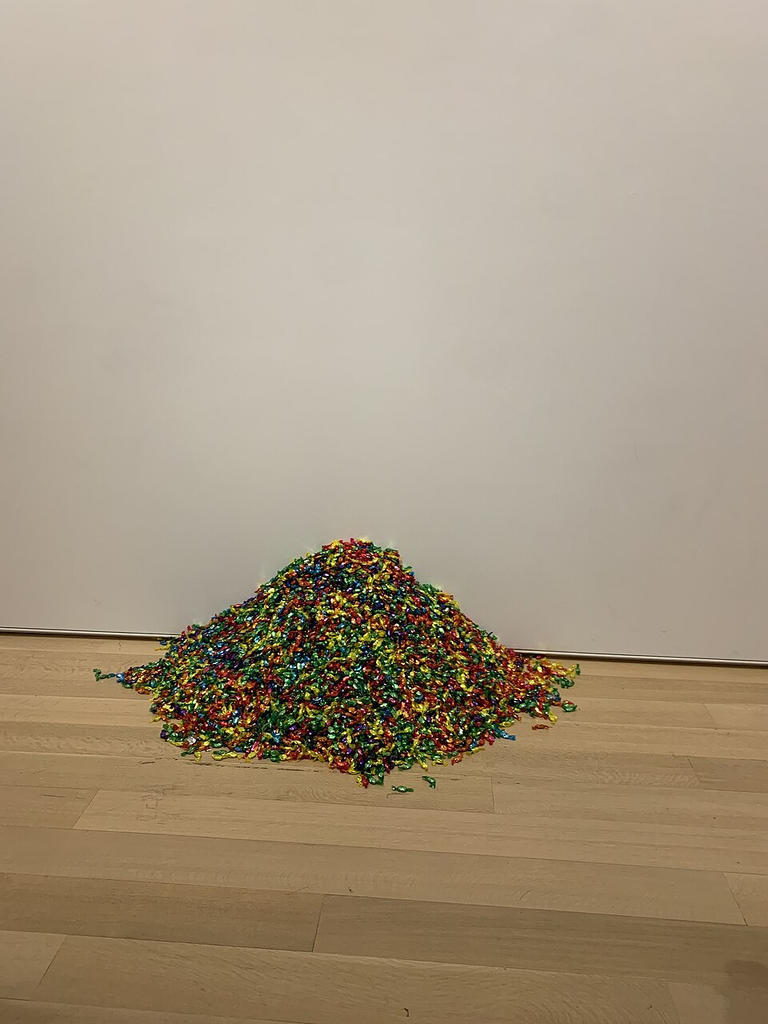
The above image is of a sculpture that consists of a pile of candy. You can walk around to different sides of it, but its really the same shape from all angles. You can look up close and read the candy wrappers. They will be familiar, ordinary. Now, here is the context: this piece is an experiential art piece that consists of candy in the weight of the artists partner before he started to die of AIDS. As the official didactic text on the Art Institute of Chicago’s website succinctly reads:
As visitors take candy, the configuration changes, linking the participatory action with loss—even though the work holds the potential for endless replenishment.
This sculpture, along with being one of the most moving I have ever seen(hard not cry), is also a great demonstration of all the historical leaps we have discussed. 1. It is conceptual, in a way only post 1900s art could be. 2. it involves heavy viewer participation-you are part of the experience. And 3. It really matters who the artist is: a gay man married to a man with AIDS, during the AIDS epidemic. Without didactic text, this sculpture would be nothing. Knowing the context, it is one of the most moving.
So all that is to say, didactic text is really just like a guide to help us see art. It is not a guide for how to feel about it, but just a way to inform us well so that we can make our own judgement.
If you go into the jungle and hire a guide, that guide might say many things to you: tell you about how animals are related to each other, what their conservation status is, and tell you about their behavior. You have the choice to believe him, or not, or think an animal is stupid or not, but to completely ignore him is to really miss out on a lot of base facts needed to make good judgements.
In his piece, Spencer suggests that the plaques describing art are orthogonal to it; I think that this is actually a very adept description. Like a sign points to a place (Chicago, 30 miles this way), the nature guide points out important things about an animal, and didactic text points to important context about the art. To say didactic text is a “non-art element” like saying that a road sign is a “non-road element”: maybe true in some way, but that isn’t a good justification for getting rid of signs.
The next question
Now that hopefully we are on the same page about the merits of didactic text, I want to talk about what fascinates me even more: why do my friends all get bent out of shape about didactic text?
Many other media and artistic disciplines that we encounter have side-along elements to explain context and nuance to us. In sports, we revere great commentators for bringing the game to life emotionally, and helping us understand the complexities mentally. Youtube channels that review music or tv shows or movies get millions of views. Many of us even reflexively check the google maps rating of a restaurant before eating there. So my real question is what is different about “fine art” that makes these explanations so unpalatable?