
At Northwestern, I used to live in a house, and among my dormmates, skateboarding is a popular form of travel. With at least 7 skateboards owned by the people of the house, the foyer can get quite cluttered. Below is an example of the foyer at a busy time, such as dinner.

In the above picture, there are 9 skateboards, including one propped up onto the fire alarm system. In order to reduce hazards and clutter, I decided to design a build a rack that would organize the boards and make more efficient use of the foyer space.
Design Constraints
Before I started designing, I identified a few constraints.
- DC-1: Ideally uses existing material
Firstly, I wanted to make use of scrap wood that we had in our basement. We had 2 large 1/2″ plywood boards and an assortment of 2x4s that added up to around 15′ in various lengths.
- DC-2: Anything cut can be cut w/ bandsaw or handheld rotary saw.
I had access to a rotary saw in the house and a bandsaw at the design shop. If possible, I wanted to stay away from the table saw because it requires oversight and would slow down the process.
- DC-3: Limited assembly tools-drill and hammer
Depending on the design, it will most likely make sense to build it on-site rather than carry it ~1/2 mile from the shop, so it must be assembled using either a hammer or a drill.
User Needs
Next, I thought more about the performance and specifications of a skateboard rack in relation to the user and came up with two main user requirements.
- UN-1: Able to hold all skateboards in foyer most of the time, or most of the skateboards at peak times.
- UN-2: Doesn’t intrude into normal walking space. The foyer rug is located approximately 16 inches away from the wall, so I set this as my maximum width.
Functional Requirements
Having defined my constraints, I then moved on to creating a list of functional requirements, based on the constraints and user needs. The main user needs that I identified were that it be able to hold all of the skateboards at most times and that it is not too wide as to not intrude into the normal walking space.
From DC-1
- The structure will be made of wood
- The structure should be designed to minimize material usage(we needed to work with what was available)
From DC-3
- The structure will be assembled using a drill and wood screws(stronger attachment than nails)
From UN-1
- Based on an empirical observation I settled on 7 as the number of skateboard capacity that it would take to fulfill this requirement
From UN-2
- The edge of the foyer rug sits about 16″ away from the wall, so I set 16″ as my absolute max-depth.
Design
Based on these Functional Requirements, I brainstormed designs but ended up getting inspiration for a skateboard rack I saw in the basement of the design building, pictured below.
I liked this design for several reasons.
- Can be built with the materials we have.
- Can be assembled with a drill and screws.
- Stacks skateboards vertically, making use of previously wasted space
- Skateboards are in an easy grab-and-go position.
- Design can be modified to not be deeper than 16″
Going off the design I had seen, I CADed up a rough model, just to prove to myself the geometry would work in the space, and then I got to building.
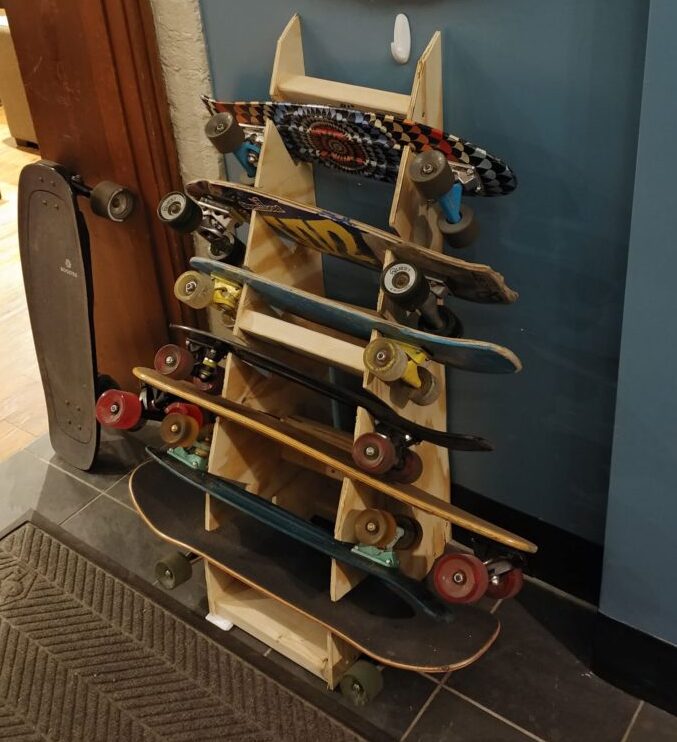
The design consists of two side plates with cross beams. The skateboards are held in notches cut into the two side plates. Overall, the design is only 10.5″ wide and supports the boards at two points in between the trucks(wheel assemblies).

I went with 7 crossbeams because I was worried that if the distance between supports was too big, we could encounter problems with the side plates flexing.
The rack ended up with a height of ~48″, which not only reduced the number of cuts that I had to make because our wood boards were already that height but also was just about the height that I needed to comfortably fit 7 skateboards in.

The finished product! I am quite happy with the way it came out, and it has held up with no problems or damage for a year.